Sumter
Regional Interim Hospital

AmericuAmAmericusAmericus, Georgia
Stegenga + PARTNERS
project
photo credit:Walter Elliott

March
1st, 2007 in Americus Georgia, a class F4 tornado smashed into the Sumter
Regional Hospital; April 1st, 2008, the first patient was admitted
into the
Sumter Regional Interim Hospital. In a mere 13 months this facility was programmed,
designed, drawn, and built, returning high level healthcare to a community
in need. This is the first time a full service, interim community hospital
was completed with the speed of urgent response. Sumter Regional Interim
Hospital is a testament to the urgent response and collaborative design
process of highly
effective and compassionate design, construction, and healthcare professionals.
This is the world’s first flat pack steel-module-built community hospital.
The Interim Hospital was a FEMA and GEMA (Georgia Emergency Management Agency)
funded project; FEMA brought forward the flat pack structural modules. These
pre-fabricated modules are primarily utilized by military logistical support
and emergency response housing. The modular system has been used to provide
emergency housing following Hurricane Katrina, but the modules had never
been used for a community hospital project of this scope or scale. The architects
developed an innovative design for the full-service hospital using 354 pre-fabricated
ten foot by twenty foot by fifteen foot modules stacked next to each other.
The plan included four operating rooms, labor and delivery rooms, a nursery,
emergency department, intensive care unit, diagnostic imaging facility, patient
rooms, and food service departments.
This project is a precedent for how to restore full healthcare service in
an emergency disaster relief situation. The program of the hospital is laid
out
rationally in order to utilize as compact a footprint as possible while still
allowing for a user-friendly and compartmentalized hospital. From the lessons
learned with this project the timeline can be reduced. If catastrophe befalls
a hospital, full service care for a geographical area can be restored within
months, not years. Just because a community is recovering from a natural
disaster does not mean that patient care should suffer. The global aid community
can
use this method to construct effective semi-permanent field hospitals with
truly sterile facilities to enhance patient care.
The original Hospital was a 143-bed facility constructed over three phases
beginning in 1953. Construction of the replacement hospital is expected to
begin in late 2008 to early 2009. The interim facility improves the level
of care and performance by returning full service healthcare to the region.
Patients
have been forced to travel to far off neighboring communities in: Albany,
Columbus, and Macon, Georgia in order to be treated.
“
It is built as strongly as the original building,” says the Chief Operating
Officer of Sumter Regional Hospital. “In fact, the facility is better
than what we had in the previous hospital. The patient rooms are larger and
private, the operating rooms are much larger, the finishes are better and now
all the services surround the patient.” The interim facility incorporates
the latest design methods from evidence based healthcare, significantly improving
and supporting the quality of care.
The interim facility serves the immediate need of providing healthcare, while
at the same time allows for a full in-depth design process to take place
for the replacement facility. The replacement facility will be superior due
to
the active interim facility. Time will not to be a controlling factor in
the design process for a new regional healthcare system.
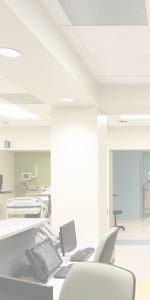
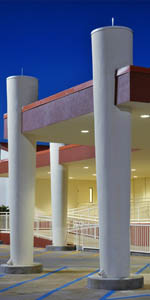
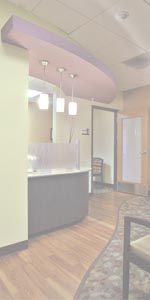
While modular in approach, it was critical for the design of interim hospital
to not only look like, but also function as well as any conventionally built
hospital. People do not necessarily select their healthcare facility because
it is attractive. They select it based on high-quality care. But, the aesthetic
of the units still needed to be appealing in order to instill confidence
in the facility.
Sustainability is about making a collective of small decisions towards the
greater good, that meet the needs and limits environmental impact. The interim
facility needed to be temporary. Temporary should not be considered the same
as disposable. If after a natural disaster the temporary structures are disposable;
then the overall amount of waste could be doubled to that before the event.
With that thought in mind a concentrated effort was made to recycle, reuse,
and choose systems with more than one life cycle.
The project is an interim facility; it is designed to be dismantled after
3 years of use, once the new facility has been opened. The structural and
envelope
modules will be packed flat into pallets again and readied for their next
deployment. These modules can be used over and over again. Reuse is always
superior to
recycling because the energy to dismantle and reassemble is significantly
less than the energy that is required to collect, melt down, reform, and
manufacture.
Many item inside are reusable or recyclable in order to reduce landfill demand.
After the hospital is dismantled the site will be a concrete pad like a big
box retailer, just as it was before any work was done on the site. Site disturbance
was kept to the absolute minimum; only additional utility trenches were installed
and the existing parking lot was re-striped for efficiency.
Much of the equipment (i.e. bed frames, I.V. stands, chart carts, etc.) was
salvaged from the damaged facility. Careful and thoughtful equipment and
furniture planning
minimized the duplication of items that will ultimately be destined for the
replacement facility.
Emergency preparedness is critical to restoring essential healthcare services
to communities devastated by disasters. Careful planning and the creative use
of innovative construction methods and building materials applied with sustainable
concepts can quickly restore those critical healthcare services without jeopardizing
patient care, safety or the environment.